Legal Monitoring
The National Commission for Human Rights (NCHR) assists the Government of Pakistan in identifying whether existing laws align with human rights obligations, and if they are being effectively enforced. Sections 9 (d) and 9 (e) of the NCHR Act, 2012, vest NCHR with these powers
NCHR undertakes research and analysis of existing legislation, policies, and administrative practices to identify gaps and inconsistencies in upholding human rights principles. Through collaboration with legal experts, scholars, and civil society organizations, NCHR ensures thorough assessments and formulates clear, well-reasoned policy recommendations. These recommendations are disseminated through various channels, including advocacy campaigns, annual reports, thematic reports, correspondence with relevant government bodies, and reports for Pakistan’s international obligations. Additionally, NCHR advises on the establishment of new legislation when necessary.
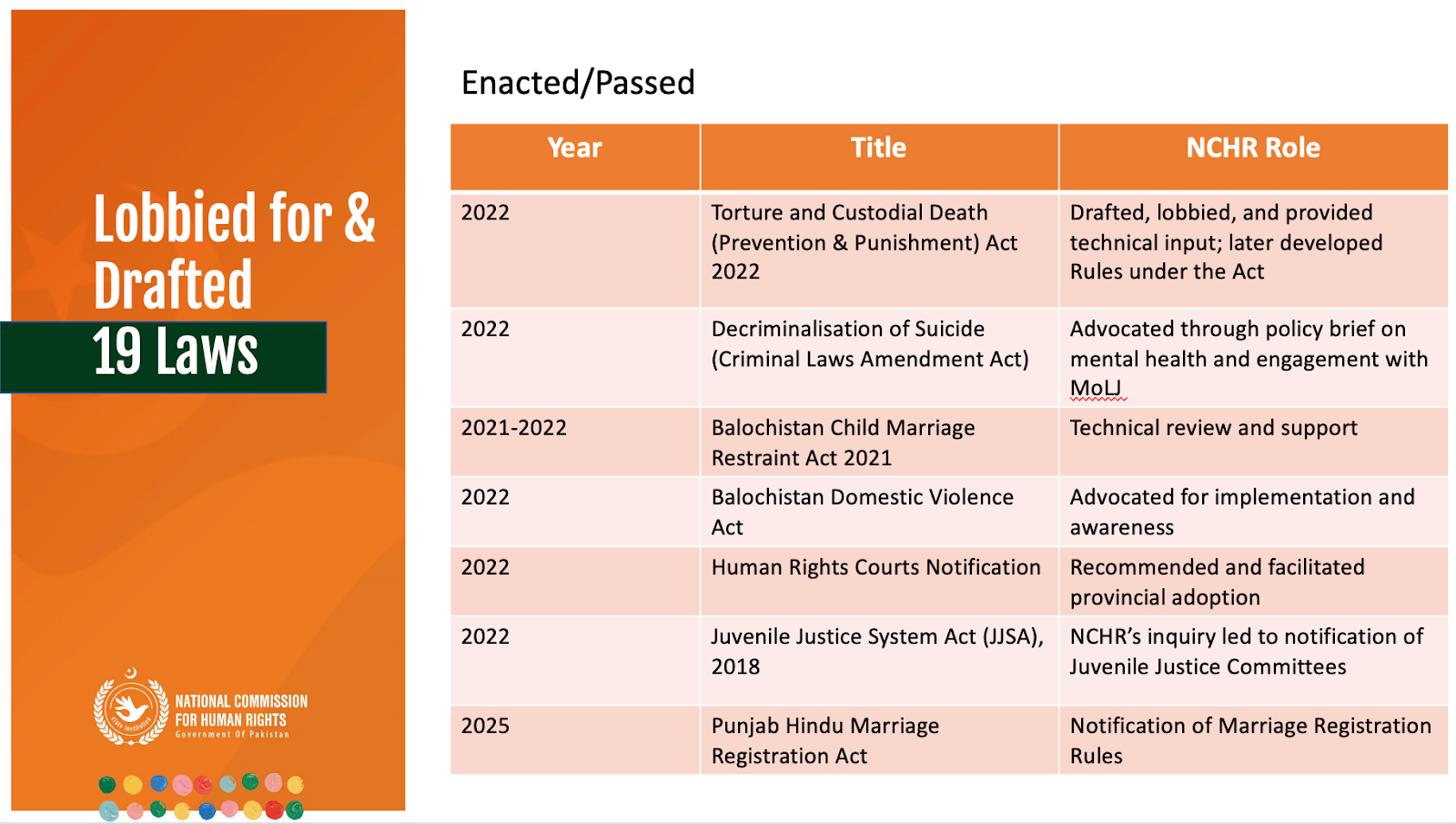
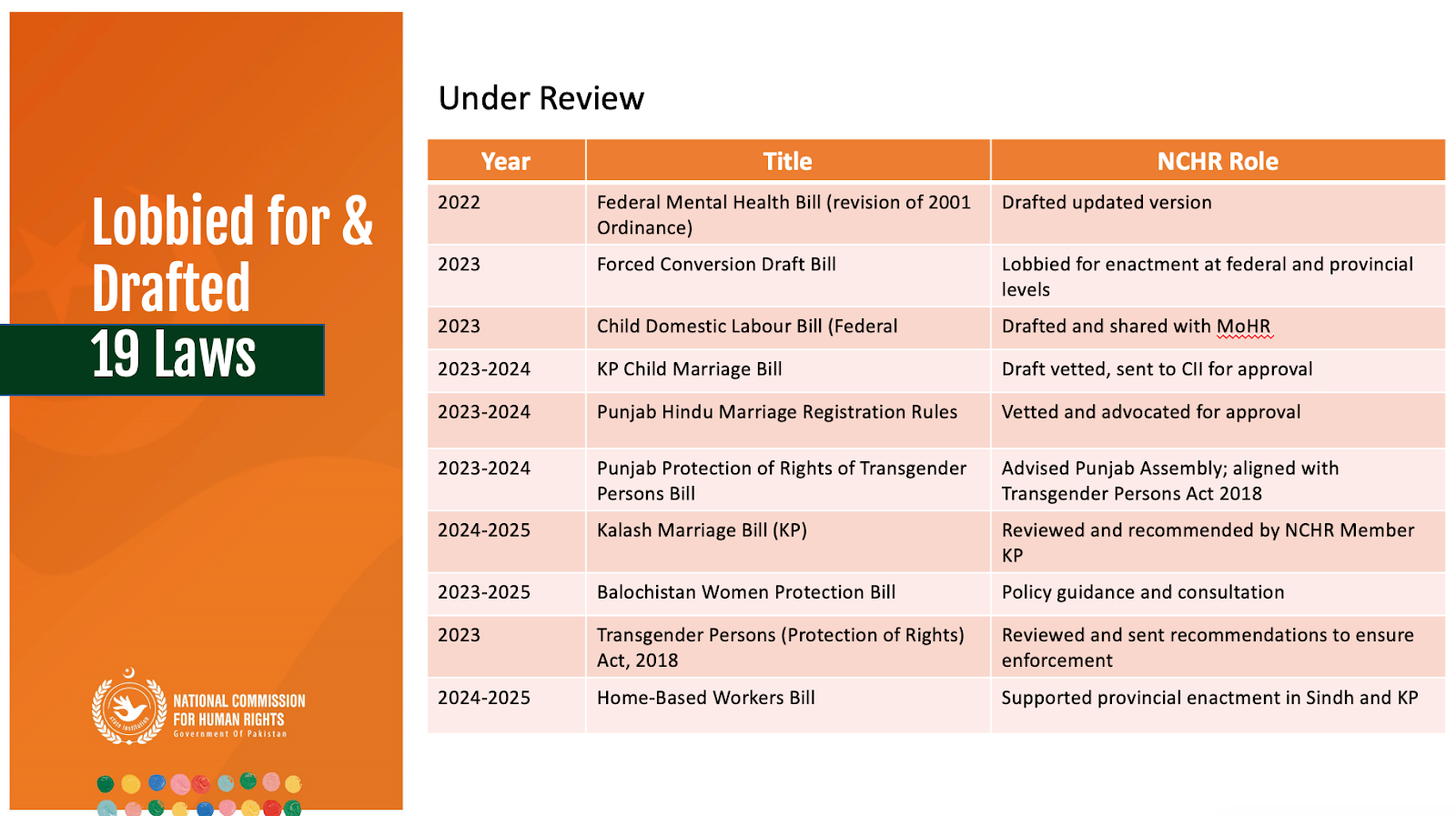
NCHR’s advocacy efforts have yielded tangible results:
- Following NCHR’s campaign and report, the government banned discriminatory advertisements targeting Christian citizens for sanitary worker positions.
- NCHR’s recommendations led to the proper implementation of minority quotas in various public sector organizations such as PIMs, Holy Family, Poly Clinic, DHQ Mansehra, Ayub Teaching Hospital Abbottabad, Benazir Bhutto Hospital Rawalpindi, DHQ Rawalpindi, Christian Memorial Hospital Sialkot, DHQ Sialkot, and Rawalpindi Institute of Cardiology.
- NCHR successfully lobbied for the reissuance of ID cards for transgender persons following their suspension post a Federal SC decision.
- NCHR advised the government and public sector organizations to ensure a minimum wage, resulting in the implementation of minimum wage standards in 45 Cantonment Boards.
- NCHR issued a letter to the Ministry of Planning, Development, and Special Initiatives (PSDP) recommending a policy change mandating Disability Impact Assessments for all PSDP projects to ensure accessibility for disabled persons. PSDP complied with NCHR’s recommendation.
- NCHR recommended for the passing of an updated Mental Health Act, advocated for the removal of Section 20 of the Prevention of Electronic Crimes Act 2016, and voiced concerns on PECA Amendment Act 2023, leading to its withdrawal by the Information Ministry.
- Advocated for the setup of Juvenile Justice Committees as per JJSA 2018, which were notified on 5/11/2022.
- Recommended the passing of a law on Domestic Violence in Islamabad, backed by a detailed analysis of the Federal Shariat Court Petition No 1/l, 2/l, and 3/l of 2016.
- Lobbied for the enactment of the “Punjab Protection of Rights of Transgender Bill” with the Secretary of Human Rights & Minorities Affairs.
- The Hindu Marriage Act mandates the registration of Hindu marriages, yet the effective implementation of this law has been lacking. Because Hindu Marriage Registrars were not notified, Hindu citizens were forced to turn to the courts to register their marriages. NCHR took notice of this issue, and after extensive lobbying, was able to initiate the designation of Hindu Marriage Registrars.
Further examples are available in NCHR’s annual reports.
NCHR emphasizes multi-stakeholder engagement and meaningful involvement of civil society in public policy making. NCHR’s team of experts continuously monitors policy implementation to ensure effective realization of human rights. NCHR’s policy interventions aim to uphold human rights principles, address systemic challenges, and foster accountability in governance, contributing to a more just and inclusive society.
Digital rights and Protection of Freedom of Expression:
- Media Fellowship on Digital Rights and Inclusion (2025):
In partnership with Media Matters for Democracy, NCHR launched a media fellowship in May 2025 aimed at building the capacity of journalists to report on digital rights, online freedoms, and issues of digital inclusion. The fellowship supports evidence-based reporting, enhances understanding of cyber laws, and promotes responsible, rights-focused journalism in the digital space.

- Complaint Cell for Women Journalists:
NCHR established a dedicated complaint cell to address cases of harassment, threats, and violations faced by women journalists. The cell is equipped to:- Conduct hearings under NCHR’s quasi-judicial powers (equivalent to a High Court)
- Assist victims in navigating investigative processes, including the filing of FIRs
- Facilitate access to safe spaces and protection mechanisms for those at risk
- Coordinate with relevant authorities such as the FIA, Ministry of Information, PTA, and FOSPA to expedite responses and ensure accountability
- Consultations on PECA:
In collaboration with the Digital Rights Foundation (DRF), NCHR convened multiple stakeholder consultations on the Prevention of Electronic Crimes Act (PECA), focusing on its amendments, implementation challenges, and implications for freedom of expression. - Multi-Stakeholder Engagement:
NCHR and DRF jointly hosted discussions with senior journalists, civil society organisations, and digital rights activists to gather diverse perspectives and identify key concerns related to PECA and digital governance.
From Promise to Action Conference
- On 9 April 2025, the National Commission for Human Rights (NCHR), in collaboration with the European Union (EU) and the United Nations Development Programme (UNDP), convened a two-day national conference titled“From Promise to Action: Advancing SDG 16 for Justice and Reform”in Islamabad.
- The conference brought together senior government officials, members of the judiciary, human rights experts, and civil society representatives to examine key challenges within Pakistan’s criminal justice system and identify pathways for inclusive, accountable, and rights-based reforms.
- Discussions focused on three core pillars of the justice system—law enforcement, the judiciary, and the penal system—with particular attention to improving access to justice for vulnerable groups, including women, juveniles, and minorities.
- Through this conference, NCHR facilitated high-level dialogue and multi-stakeholder engagement aimed at advancing justice sector reform:
- Convened national and international stakeholders to align justice reform efforts with Sustainable Development Goal 16 (SDG 16), the GSP+ framework, and international human rights obligations
- Provided a platform for addressing systemic issues such as pre-trial detention, case backlogs, legal delays, and structural inequalities
- Highlighted the importance of collective action, with NCHR leadership emphasising collaboration between government, civil society, and development partners
- Promoted the adoption of innovative justice solutions, including digital tools such as virtual courts, digital case management systems, and online legal aid services
- Facilitated thematic discussions through panel sessions and case study reviews to identify practical reform pathways.